Article
Your Growth Metric: Why You Need One & How To Find It!

There are many times that I catch myself trying to improve 20000 features of a product simultaneously, and honestly, there’s nothing more wrong...
Don’t be as stupid as I’ve been!
There are many times that I catch myself trying to improve 20000 features of a product simultaneously, and honestly, there’s nothing more wrong than this attitude. That’s the times that I’m destined to fail. Well, I’m not alone on this as 99% of people related to startups embrace the same mindset. When these people eventually fail, they think that the reason of their failure is due to their idea being awful (which could be partially true). But on most occasions, the problem is the incapability to focus on the single one growth metric that matters the most. I don’t get them wrong though; Excitement can be a bad company and also there are a ton of articles out there filled with bullshit metrics out there. Believe me, nothing will help you more than focusing on one growth metric. You have to find it and put all your efforts into improving it.
The key goal of this article is to help you find your own precious growth metric, your true North for growth.
Retention Is The Key
In an ideal universe (in terms of product growth), a great product brings customers and these customers constantly use it and spread the word bringing in, even more, customers, and so on. But there’s no such thing as ideal in a universe bound by entropy. [bctt tweet="The single most important thing for #growth is #retention!"] Want to know if you’re running a viable business? Give a look on your retention curve. Does it look anything like this?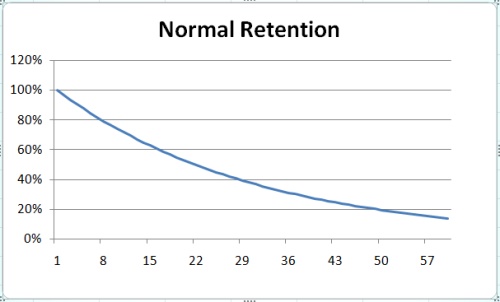 Btw the graph above relates to the memory retention curve of a healthy human brain. Your product works exactly like a memory on customers' minds!
If you’re thinking “Hell Yes!”, then you’re on a great road, to begin with. It means that you have Product Market Fit which is a prerequisite for growth.
If your retention curve intercepts the X axis you should probably take a look on your product again before embarking on an expedition to find your growth metric.
Don’t get me wrong. A great product is not defined by the flashy features but instead by its impact on the user’s everyday life.
 Let’s say that you know your retention rate. Is it enough?
You can figure it out. Alex Schultz in his lecture on growth puts it rather straightforward.
It really depends on your niche. A good retention rate for an eCommerce is totally different than a good retention rate for a growth hacking agency.
As I’ve said earlier the impact on the user’s everyday life is crucial. There’s no such thing as a once-off product (unless if we’re talking about a limited item).
Even if you own a tattoo studio people could come back to get another great piece from you ( BTW, there are statistics that approximately 90% of people getting tattooed, get inked at least once more).
Finding Your Growth Metric
Assuming you’ve achieved product-market fit, thus people stick with your product, it’s now time for you to find the one growth metric that matters the most for your business. But what does a good growth metric look like? As Sean Ellis in this Slideshare presentation exceptionally states, your growth metric should be:- Easy to understand.
- Relevant to your goal.
- Timely.
- Instantly useful
Where To Start
The simpler your growth metric is, the easier for you to organize your efforts towards your goal. Now, in order to discover this cradle of growth you have to start from the basic elements of your industry. Allow me to show you some examples of growth metrics divided by industry (plus some guesses from my side):Transactional
An eCommerce’s success relies on things like cart conversion, size or abandonment. I suggest starting from the number of orders per month or average cart size per order.Collaborative
Communities like Inbound.org or GrowthHackers.com are as good as the engagement of their members. The daily amount of comments, posts or votes are a must-watch. Do you know how Inbound.org and Reddit solved the problem? They have a Karma system. People have something to gain by commenting which creates the opportunity for other people to share their thoughts, thus comment more.
SaaS
The growth metric you’re going to choose for your SaaS product really depends on your business model and the type of the tool. For example, in Viral-Loops track the monthly number of campaigns that their users start. Some other guesses are that Autopilot’s growth metric is the number of journeys a user creates, or for Convert the number of A/B test campaigns a user creates per month.Media
My humble opinion is that a media website’s success is tightly bond with the news being spread. The number of shares is the king here. Go ask Unilad! Buzzfeed is all about viral content because that’s what gets shared and brings more and more traffic.
Game
I think that the majority of people have at least one game installed on their smartphone.There are also many types of games (I’m not talking about genres):- Free with in-app purchases.
- Paid to provide a demo.
- Freemium games with a ton of stupid banner ads (I’ve your still using those, I propose to try Native Adverting instead.
App
The truth is that nowadays there’s an app for nearly everything. That’s why all the categories mentioned above could probably fit in here too. For the sake of the example, I’ll use messaging apps. What’s the number one growth metric for a messaging app? That’s right; SENDS! Why? Because the reason people use messaging apps is to communicate with their fellas via -wait for it- text messages. 1K people sending 5 messages per day, are more valuable to you than 1M people that send 1 message per week.What’s The Catch?
I beg you to not fall into the trap of going for a growth metric that another company has already gone for. Remember, you have a different company, different audience, and different customer journey. What if Jared Leto, Heath Ledger, Jack Nicholson and Cesar Romero impersonated the same version of the Joker? Or what if Luke, in “The Force Awakens” has turned to the Dark Side, just like Anakin did in “The Revenge Of The Sith” (I cross my fingers that this doesn't happen in 'The Last Jedi')? That would be BORING! I believe you can get more creative than that.
Want to know the secret to find your one growth metric? Well, it’s not a secret at all. You have to find what’s the core value of your product and relate it to a very simple number. That’s all.
The simpler you think, the more possible it gets to find your growth metric.